Add your references
Paste a bibliography or upload a supported document. Review the parsed citations before starting your check.
 Citation Firewall
Paste in a bibliography. Citation Firewall tells you which sources are verified—and takes you directly to the ones that need attention.
Citation Firewall’s primary purpose is to triage a bibliography for citations that may refer to nonexistent or hallucinated works. It checks each entry against independent scholarly and specialist sources and identifies bibliographic details requiring human review. CF deliberately errs on the side of caution: human research can often confirm a real source that automated databases cannot.
10 free bibliography checks · Up to 50 citations each
No payment required for the trial.
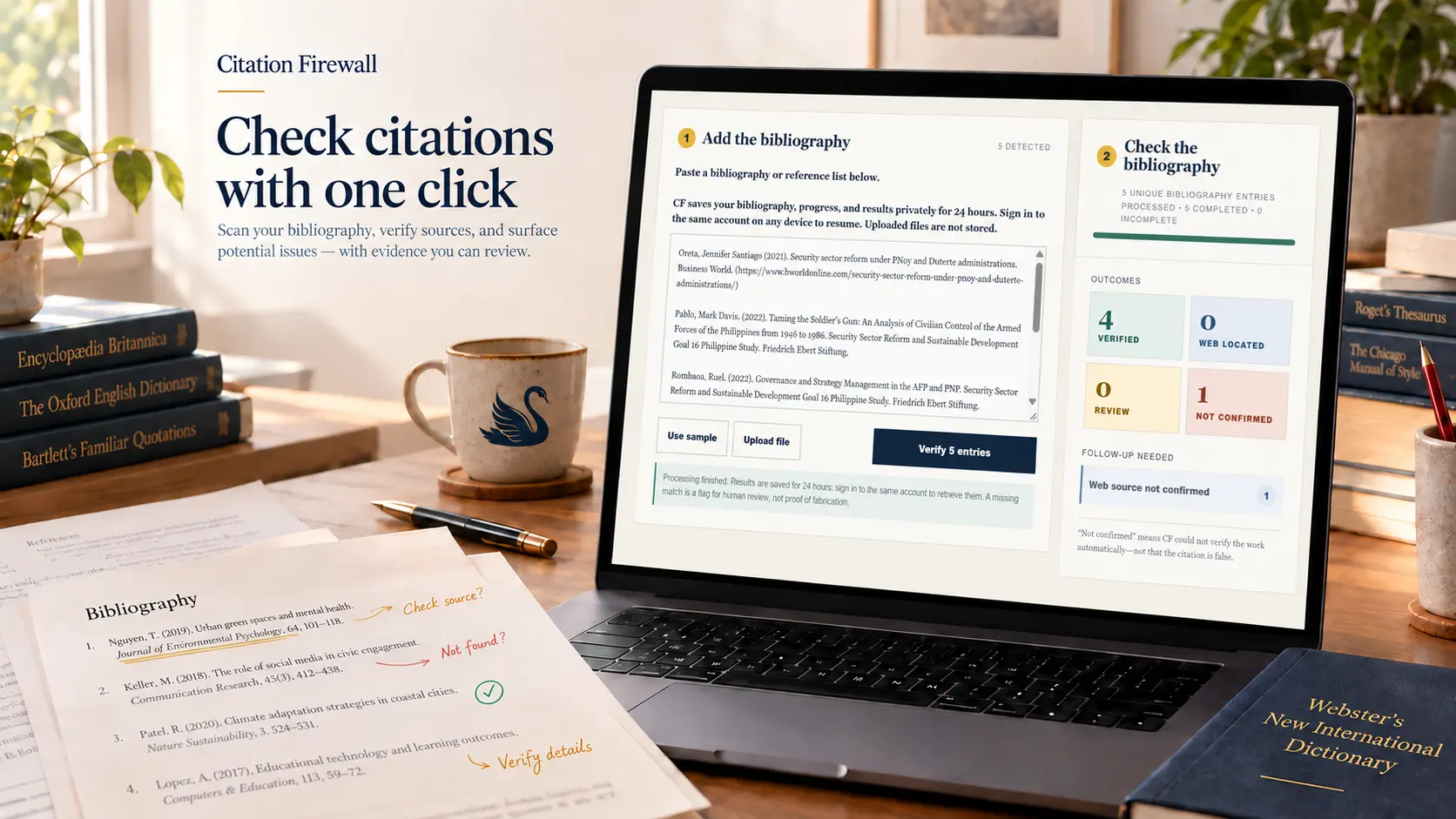
FROM BIBLIOGRAPHY TO EVIDENCE
Paste a bibliography or upload a supported document. Review the parsed citations before starting your check.
CF searches appropriate scholarly and bibliographic sources, expanding the search when the evidence is insufficient.
See the evidence, inspect differences, and distinguish unresolved citations from interrupted searches. Print or save your report as a PDF.
CF uses a staged search. It begins with the fastest, most relevant records, stops when the bibliographic evidence is sufficient, and sends unresolved citations to slower specialist sources only when their subject or publication type warrants it.
DIRECT & GENERAL
Supplied official source pages; Crossref DOI Registry; Crossref; OpenAlex; Google Books; Open Library; and JSTOR citation records when a stable identifier is supplied.
CONDITIONAL & SPECIALIST
PubMed and Europe PMC; ERIC; DBLP; arXiv; DataCite; OpenAIRE; Internet Archive; selected university repositories; Semantic Scholar; specialist authority catalogues; and authoritative academic-publisher records found through exact-title discovery.
AGGREGATED COVERAGE
OpenAlex incorporates records from many sources, including DOAJ, PubMed, PubMed Central, Crossref, institutional repositories, and other scholarly indexes. CF describes this as coverage through OpenAlex—not as a separate direct search.
FOUNDING PUBLIC-BETA PRICING
Start with 10 free bibliography checks. Choose a subscription or a one-time purchase when you need more checks. People who subscribe during the public beta keep their founding price while that subscription remains active. Prices for new subscribers may change before general release.
FREE TRIAL
10 bibliography checks in total
ANNUAL
50 bibliography checks each month
MONTHLY
50 bibliography checks each month
ONE-TIME PURCHASE
100 bibliography checks
Prices are in USD, plus applicable tax. Subscriptions renew automatically until canceled. One-time purchases do not renew. No automatic overage charges.
A LITTLE CLARITY
CF triages a bibliography to surface citations that may refer to nonexistent or hallucinated works, while separating those from real sources with damaged or incomplete bibliographic details. It narrows the work; it does not replace human judgment.
No. It means CF could not independently confirm the cited work. CF draws on 14 scholarly databases and catalogues, plus official source pages and specialist repositories, selecting sources appropriate to each citation. This gives CF broad coverage, but databases continually change and no combination can guarantee 100% coverage. A real source may still be absent from their records, so unconfirmed citations need human review.
A matching work can have metadata differences that deserve review. Editions can matter, but a mismatch is a different finding from a potentially invented source. Inspect the records and the cited edition before deciding.
No. CF checks citation existence and bibliographic details. It does not determine intent, detect plagiarism, or establish that a source supports the claim made about it.
CF searches supplied official source links, the Crossref DOI Registry, Crossref, OpenAlex, Google Books, Open Library, and JSTOR citation records where appropriate. If those do not settle the citation, it can route relevant work to PubMed and Europe PMC (biomedicine), ERIC (education), DBLP and arXiv (computing and preprints), DataCite (registered research outputs), OpenAIRE and university repositories, Internet Archive, Semantic Scholar, specialist authority catalogues, and exact-title scholarly discovery. OpenAlex also aggregates records from sources including DOAJ, PubMed and PubMed Central. CF does not claim to search every underlying source directly, and it does not search every database for every citation: it stops when sufficient evidence is found and uses slower specialist sources only when the citation warrants them. Every report records what was searched, skipped, unavailable, or not applicable.
Google Scholar restricts automated access, so CF checks citations through scholarly databases, catalogues, publisher pages, and repositories instead. These sources cover many of the same works, but their coverage is not identical. Google Scholar can therefore be useful for following up on a citation CF could not confirm—which is why ‘not found’ calls for human review, not a conclusion that the source is fabricated.
CF spaces out requests and retries temporary failures. If it still cannot finish, the report identifies an incomplete search and recommends retrying. This is not evidence against the citation.
Keep the checker open while your bibliography is being checked. Save or print your report before leaving or refreshing. If you lose the results, you can run the check again; it uses another bibliography check.
These may not have a published database record. CF flags recognized personal communications for the appropriate manual review rather than treating them as missing publications.
BRING A BIBLIOGRAPHY. FOLLOW THE EVIDENCE.
10 free checks. Your judgment stays at the center.